policy

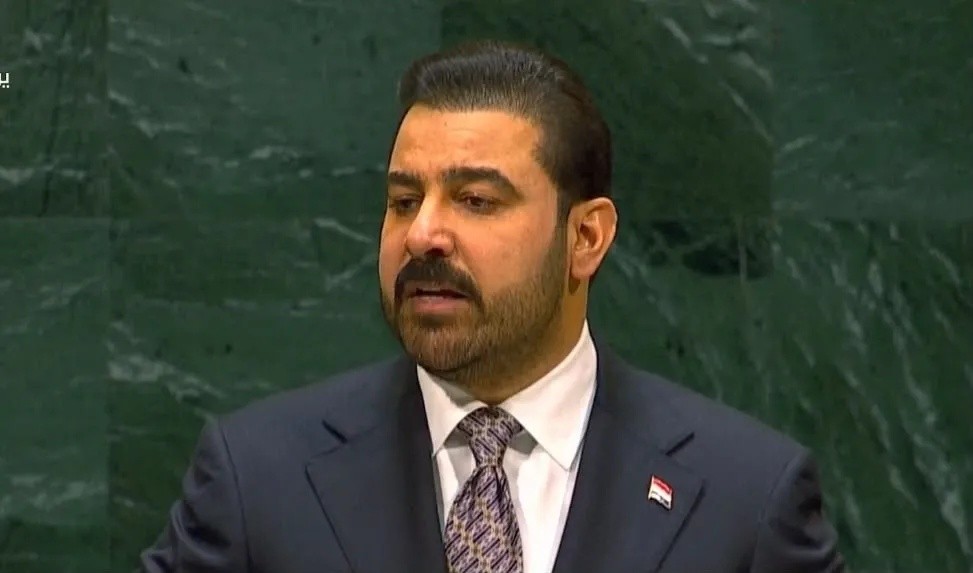
Prime Minister Ali Faleh Al-Zaidi affirmed on Friday that Iraq aspires to establish its position as an effective regional economic power and a bridge for dialogue and cooperation among the peoples of the region, in the context of his call to the international community to invest in his country. Speaking at the 81st session of the United Nations General Assembly, Al-Zaidi expressed pride in representing the Republic of Iraq, the land of early civilizations, the cradle of writing and law, and a founding member of the UN. He reiterated his country's commitment to the UN charter and principles, outlining Iraq's vision for its future, its region, and the global landscape during this critical phase. Reviewing the historical challenges faced by the nation, Al-Zaidi clarified that Iraq has perhaps been more exposed than others to the devastations of wars, enduring sieges and terrorism. Its people paid a heavy price in lives, resources, and development opportunities. Despite these decades of conflicts that made Iraq a battleground, the Prime Minister stressed that the country now confidently articulates its future vision, aiming to exert influence as a pivotal economic force and a bridge for regional dialogue and cooperation. The Iraqi government's current vision, the Prime Minister stated, is rooted in a firm national resolve to restore the rule of law and strengthen state institutions, thereby enhancing public trust. He affirmed these central priorities, stressing the government's determination to consolidate state authority as the sole decision-maker in peace and war, ensuring all weapons remain with constitutional institutions. Law, he declared, must be the arbiter, and national interest the guiding compass. Executive measures, he noted, are progressing correctly, forming the foundation for institutional governance, sovereignty protection, stability, and a conducive environment for development and investment. Regarding international relations, Al-Zaidi highlighted the conclusion of the international coalition's mission in Iraq as a turning point, shifting relations with strategic partners from military to economic and developmental cooperation, serving mutual interests. He posited that this enhances momentum for completing Iraq's security and military capabilities to protect its land, people, and sovereignty, following the triumph over terrorism. To ensure sustained international cooperation, he urged global partners to secure borders, address vulnerabilities, and remain vigilant against environments that foster extremism. On the domestic reform front, the government is actively combating corruption and protecting public funds, pursuing fundamental and sustainable treatments to enhance performance and improve services. These initiatives aim to forge a strong state and a diversified, modern economy that aligns with global technological and digital transformations. To this end, the government is leveraging successful expertise and innovative experiences in economics, finance, and business to accelerate reform and foster a secure environment for national and foreign investment. Al-Zaidi stated that this ambitious vision is grounded in Iraq's significant assets, including vast resources and investment opportunities across energy, industry, agriculture, transport, and technology sectors. Its exceptional geographical location further integrates the Iraqi economy globally. The vision seeks to transform Iraq into an active regional productive partner by progressively reducing the rentier economy's impact, promoting open market policies, developing productive and export capabilities, and investing in infrastructure and services. Consequently, a roadmap supports the private sector, offering essential legal, tax, and customs incentives for business growth and foreign trade, fostering effective global market partnerships to accelerate sustainable development. Iraq's direct influence in global energy is clear, with its government adopting an ambitious program to boost crude oil production, aligning with proven reserves, and developing gas fields. This includes expanding refining capacities, derivative production, and petrochemical industries. The goal is to establish Iraq as a global energy hub, leveraging its potential for sustainable regional and international security and stability. Concurrently, the government expresses concern over repercussions related to transport and maritime navigation freedom, which have driven global energy price hikes. To mitigate these risks, Iraq is diversifying oil export outlets and developing energy pipelines and corridors connecting with Turkey, Jordan, and Syria to reach global markets, aiming to enhance energy security and supply route diversity. Economic diversification through genuine partnerships is a central strategic objective of Iraq's economic policy, the Prime Minister stressed. Consequently, the government prioritizes enhancing economic and industrial development across all sectors. The "Development Road" project embodies Iraq's comprehensive vision for regional integration, stability, and connectivity. This project, a strategic corridor for trade, investment, industry, and energy, will link East and West from the Grand Faw Port to Turkey and onward to Europe. The government seeks open partnerships for this project with all neighbors and friends, believing economic interests foster prosperity. When regional nations are connected by ports, railways, energy lines, trade, and investments, their stake in maintaining stability increases. From the UN platform, Al-Zaidi urged the world: "Invest with Iraq, for it possesses the resources, market, location, and will to build a new economy." He added that the government diligently fosters partnerships creating mutual interests, job opportunities, technology transfer, and enhancing Iraq's productive capacity. Emphasizing the importance of security and peace, Al-Zaidi affirmed that national security and sustainable peace are shared responsibilities under the UN Charter. True stability, he stressed, is built not through wars, but through mutual interests that make cooperation more fruitful than conflict. Iraq's vision aims to shift the region from conflict to integration, competition to cooperation, and resource depletion to developmental investment. Al-Zaidi extended Iraq's hand to all, based on respecting sovereignty, non-interference, good neighborliness, strengthening mutual interests, and resolving differences through dialogue. He reiterated Iraq's support for dialogue and diplomacy to defuse crises and facilitate trade via Iraqi territory, offering significant alternatives to complex routes. Iraq believes responsibility for global peace and security demands ending conflicts through negotiation for a secure future, preventing new wars. Al-Zaidi made a historical reference to the Code of Hammurabi, a copy of which is at the UN headquarters, stating: "Laws were established to prevent the strong from oppressing the weak." He observed, however, that in today's world, the weak are often oppressed because "the law of the strong" prevails over "the strength of the law." Therefore, he stressed that the Palestinian issue remains central to any discussion of regional stability, asserting there can be no security in the Middle East without a just solution affirming the Palestinian people's right to their land, self-determination, and a sovereign state. He also underscored the critical importance of facilitating humanitarian aid access and protecting civilians. Iraq's security aspirations extend beyond conflict resolution to confronting climate change, desertification, and water scarcity – challenges directly impacting its food security. The country affirmed its adherence to legitimate and fair water rights, advocating for joint water resource management in accordance with international law and cooperation principles. Regarding other security risks, Al-Zaidi noted Iraq continues to combat organized crime, cooperating with international partners to counter its dangers and thwart cross-border drug trafficking. He called for enhanced information exchange and international coordination to avert this societal threat. Concluding his address, Al-Zaidi affirmed that the Iraqi individual remains the ultimate focus of the government's efforts. Leveraging the high youth demographic, the government aims to empower them as a cornerstone of the future economy through education, diversified employment, entrepreneurship support, and digital economy initiatives. This aligns with constitutional commitments to human rights, freedoms, women's participation, child welfare, and preserving national, religious, and cultural diversity. Al-Zaidi confidently invited General Assembly attendees to greater openness towards Iraq, asserting its role as a genuine partner capable of contributing to regional security, stability, and accelerated development across all sectors. He concluded that Iraq, far from being marginalized, is the heart of history and the pulse of the present, worthy of partnership for the future. He also reaffirmed Iraq's support for the UN's role, praising its joint efforts through the UNAMI mission, and pledging productive cooperation to mitigate the impacts of global conflicts.