Global

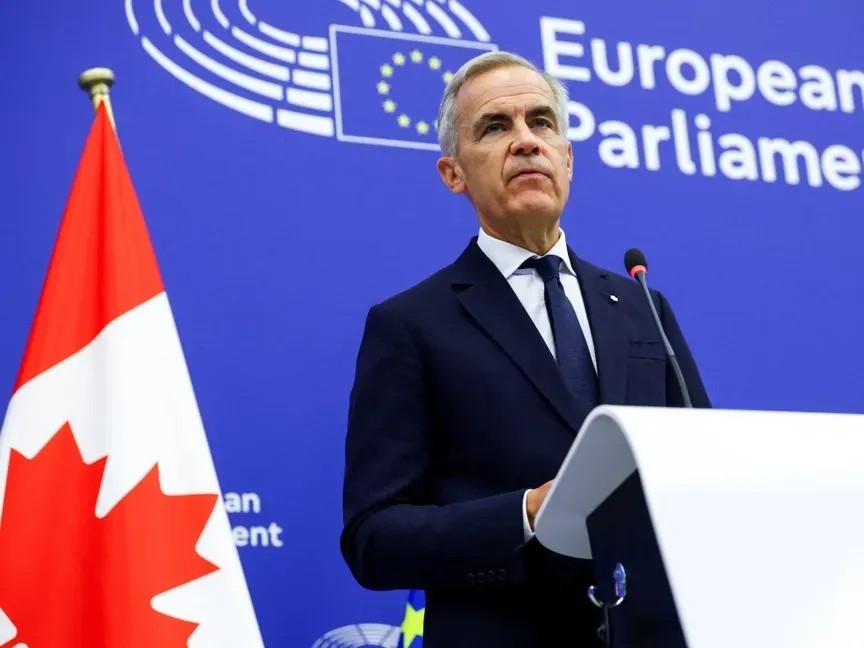
Mark Carney, the former Prime Minister of Canada, has stated that his country is working to reduce its economic and strategic reliance on the United States amid escalating trade tensions and threats from then-President Donald Trump. Carney revealed that he even studied the possibility of a U.S. military action against Canada, characterizing it as an "extreme risk," although he does not consider it the primary likely scenario. In an extensive interview held on Wednesday in New York, Carney confirmed that he spent the past year preparing for the "extreme risk" that the American President might order "military action against Canada." Despite these preparations, he noted that he and Trump spoke "frequently," even after trade talks collapsed last month, describing the relationship between them as tense yet continuously evolving. Carney detailed how Ottawa is systematically working to diminish its dependency on the United States in critical technology sectors, ranging from space satellites to fighter jets. These efforts aim to make Canada significantly less vulnerable to American threats. He also presented a comprehensive plan to diversify Canada's relationships with its partners and suppliers, expressing his belief that even with a different U.S. administration in the future, Canada "will be a better partner to the United States because of what we are doing." This strategy includes reducing reliance on Elon Musk's Starlink satellite system, exploring alternatives to purchasing F-35 fighter jets, and deepening economic ties with the People's Republic of China. When asked if he took Trump's threats of making Canada the 51st U.S. state seriously, Carney indicated that he carefully studied the possibility of the United States taking military action against his country but declined to elaborate on the details of those assessments. Carney, who previously served as the Governor of the Central Bank for both Britain and Canada, highlighted that his approach to global issues is rooted in a meticulous assessment of worst-case scenarios and the development of proactive plans to address them. He added, "I think it's your responsibility in these positions to consider improbable extreme risks. This is just risk management. This isn't the base case, but it would be irresponsible not to be prepared for it." Over the past year, Carney emerged as one of the most prominent global leaders to directly challenge statements from then-President Trump. Simultaneously, he began charting a course to lessen his country's dependence on its powerful neighbor, which was sometimes perceived as leveraging its influence in the relationship. Many leaders worldwide viewed Carney as a model for dealing with an ally that is volatile and unreliable, yet remains vital for Canada's national security and economic survival. However, few leaders articulated their interests as clearly and candidly as Carney, who used a speech at the World Economic Forum in Davos, Switzerland, earlier in the year to outline a strategy for navigating this shift in relations. He declared then, "You either completely retreat into yourself, or you diversify your relationships," a clear reference to the choices facing his nation. Nevertheless, Carney emphasized his continued "frequent" communication with Trump, noting that they had spoken "a number of times" since the breakdown of trade talks last month. The Canadian leader stated on Wednesday, "From my perspective, we have a good relationship in the sense that we can pick up the phone and talk to each other about issues. He's direct, and I'm direct about our positions. And that's much more efficient, and so you know that that's going to be there and continue." Carney also advocated for the view that what is good for Canada often aligns with the interests of the United States, thanks to decades of economic integration between the two countries that has contributed to shared stability and prosperity. He cited the automotive industry as an example, which is highly integrated across the U.S.-Canadian border but found itself at the heart of the Trump administration's tariff policy against Canada. Carney commented, "For my entire life, and I'm 61 years old, we've had an integrated auto sector," adding that dismantling this deep relationship and relocating all automotive production back to the United States is not sound economic policy. He affirmed, "We think that makes no sense." Carney indicated that the path for resuming negotiations with the United States remains open, which could pave the way for reviving the trade agreement that collapsed in late August. Since then, both countries have imposed a series of reciprocal tariffs, and statements have been marked by a threatening tone, particularly from Trump, who repeatedly described Canadian leadership as "mean." Carney, however, downplayed the significance of these remarks. Carney stated, "Is there a mutually beneficial trade agreement between Canada and the United States? Absolutely, absolutely there is one." He expressed interest, for instance, in including potash in the negotiations. Canada supplies about 90% of U.S. potash imports, a key component for fertilizers. Trump had previously stated earlier in the week his desire to replace Canadian supplies with potash from Belarus. Domestically, Carney faced pressure to use Canada's most critical and sensitive exports to the United States—energy—as leverage in the trade war. Canada accounts for approximately 60% of all U.S. oil imports and is also a major source of electricity for American homes and industries. Carney expressed strong reluctance to limit these exports to the United States, impose tariffs on them, or restrict them in any other way. Despite his optimism about the possibility of resuming efforts to reach a trade agreement, Carney underscored his full awareness of the areas where Canada needs to reduce its reliance on the United States. Regarding "Starlink," the satellite communication system operated by Elon Musk's SpaceX, Carney stated, "We will diversify away from it, no question about that." He attributed this decision to previous disruptions and Musk's hesitation to provide data to Ukraine that would allow it to target parts of Crimea and Russia. Carney acknowledged that alternative satellite networks are still less capable and flexible, but he added that "from a defensive perspective, and certainly in cooperation with other partners, European and potential Korean, you can achieve greater scale and reduce that dependence." The Canadian government is currently reviewing its planned order for 88 F-35 fighter jets from Lockheed Martin and is considering an alternative offer to purchase Swedish Gripen fighters from Saab. Carney did not state his final position on this decision, but he emphasized his desire to use the recent increase in Canada's defense budget to acquire aircraft that perform exceptionally well in the Arctic region. He remarked, "It's a real decision because of capability differences, because of strategic dependencies, because of the economic return." In a broader context, Carney reiterated on Wednesday his long-held stance that the global financial system, which is entirely reliant on the U.S. dollar, is unsustainable. He asserted that a transition toward a multipolar global system, incorporating multiple reserve currencies, "would provide greater resilience" for the international financial system.