Global

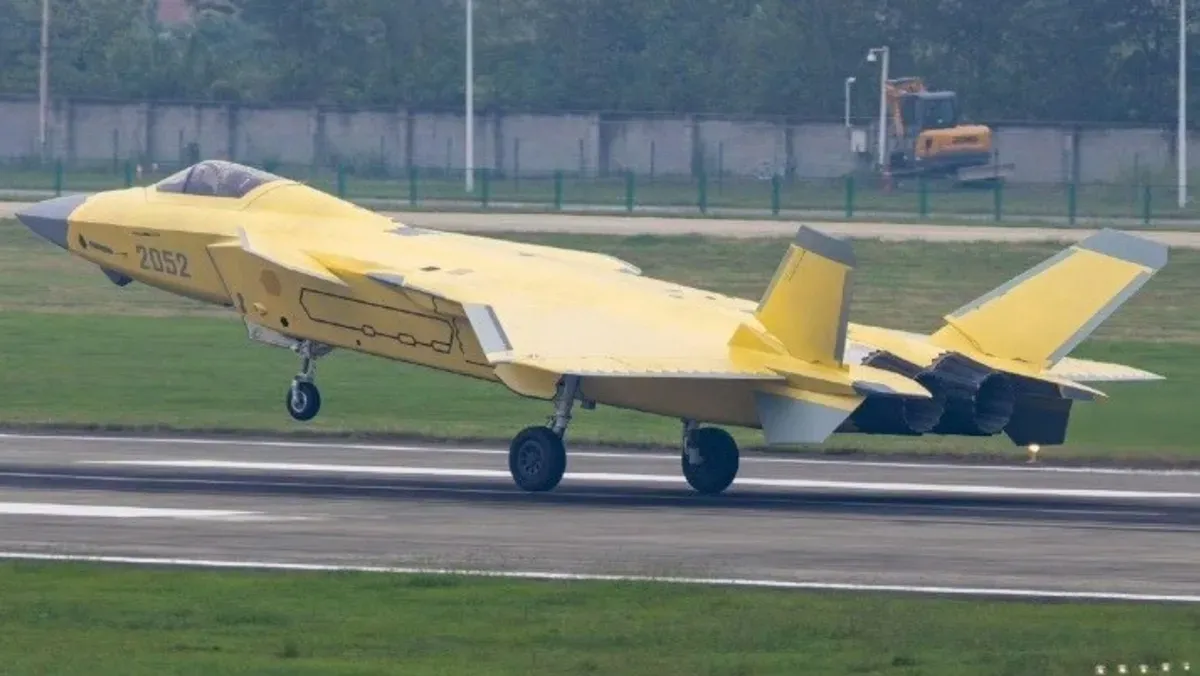
New footage published on Chinese social media showed a J-20A fifth-generation fighter aircraft with a long flight range, still painted in the factory's original yellow primer, indicating it was recently produced and equipped with next-generation WS-15 twin turbofan engines.
Video footage published for the first time last December confirmed that the first batch of J-20 aircraft equipped with twin WS-15 turbofan engines completed serial production, with the first test flight of a serial production aircraft equipped with these engines taking place on December 27, according to Military Watch magazine.
The WS-15 engine is an entirely new design, not an improved version of a previous design, making its entry into service a milestone in the Chinese combat aviation industry.
In comparison, the last new engine for an American fighter to enter service was the F119, which underwent its first flight test in 1990 and began integration into serial production aircraft in 1997, and subsequent engines were derived from this engine or older designs.
Expected step
Footage released by Chengdu Aircraft Industry Corporation, the main developer of the J-20, last January showed, for the first time, a number of new aircraft conducting test flights equipped with the WS-15 engine.
China has doubled the production efficiency of components for its J-20 stealth fighter jets, known as the "Mighty Dragon." Learn about its specifications.
The integration of the WS-15 engine had been long anticipated, as it was first seen integrated into a J-20 in a single configuration during a test flight in January 2022, before making its first flight in a twin configuration in June 2023.
This engine significantly improves all aspects of the J-20's flight performance, as well as its range, while providing more power to onboard subsystems and reducing maintenance requirements.
Considered "one of the most advanced fighter aircraft engines in the world," the WS-15's thrust-to-weight ratio is matched only by the F135 engine that powers the fifth-generation F-35 fighter, among known engine types.
The engine's efficiency contributes to extending the already long range of the J-20, making it one of the two longest-range fighter aircraft types in the world along with the much larger Russian Su-34.
The Chinese military replaced J-11B fighters with new fifth-generation J-20A fighters, representing a significant upgrade to the combat unit's capabilities.
Production expansion
The entry of the enhanced J-20A aircraft and its new engine into serial production coincides with a major expansion in J-20 production, indicating that the Chinese Ministry of Defense may have been waiting to upgrade the capabilities of this fighter before increasing its procurement investments.
This is not new, as production has seen a noticeable expansion since 2021, when the J-20 design was optimized and the aircraft began integrating WS-10C engines.
A recent report by the Royal United Services Institute (RUSI) estimated that thanks to this massive expansion in production, the Chinese Air Force will possess around 1,000 J-20 aircraft by 2030, expecting production to continue at a rate of 120 fighters annually.
No other fighter type is being procured in this volume by any air force in the world, and these investments, along with the J-20's world-leading capabilities, are expected to reinforce the significant advantages the Chinese Air Force enjoys in its aerial combat capabilities.
The WS-15 engines are also expected to completely replace WS-10C engines in production in 2026, and may have already done so.