policy

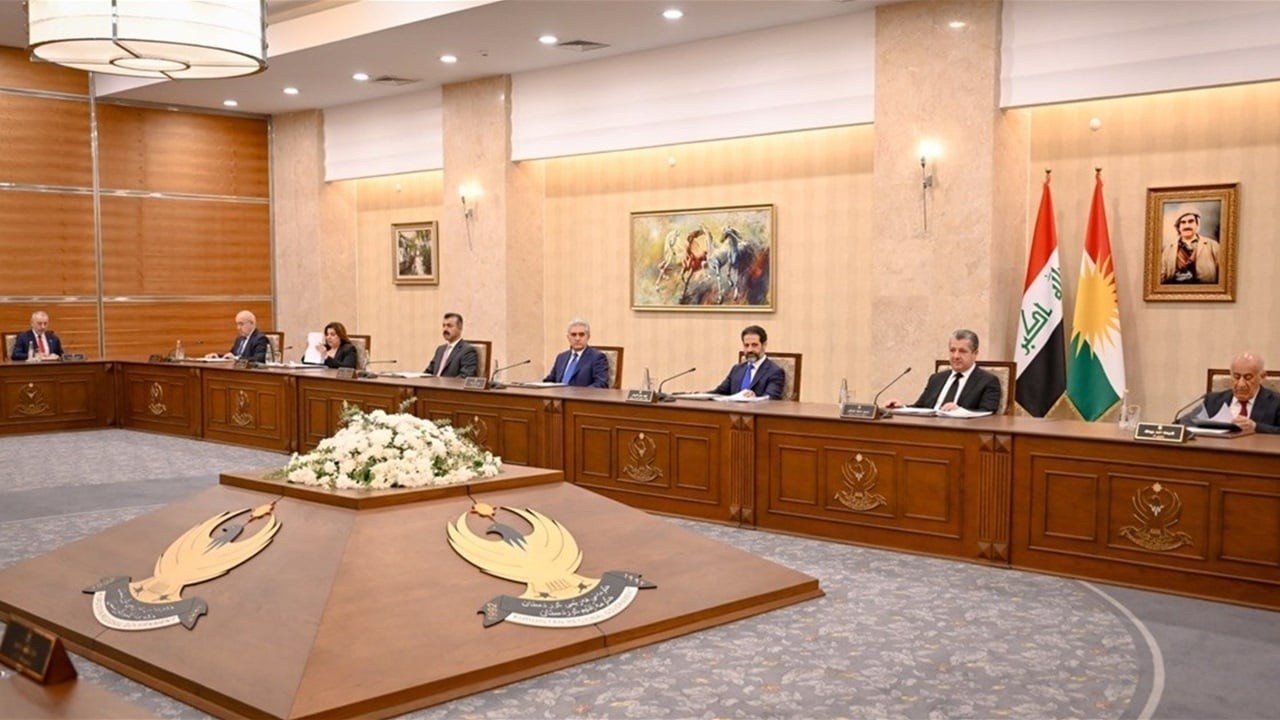
The Council of Ministers of the Kurdistan Region convened its regular weekly meeting today, Wednesday, September 16, 2026, under the leadership of Prime Minister Masrour Barzani and the presence of Deputy Prime Minister Qubad Talabani. The meeting focused on vital issues related to the financial and constitutional entitlements of the Region within the federal budget, in addition to educational matters. The Council expressed its rejection of the population percentage for the Region recently determined by the federal government, emphasizing the need for its correction to ensure a fair share in the upcoming budget. At the outset of the meeting, a detailed review was presented regarding the preparations of the Ministries of Higher Education and Scientific Research, and Education for the launch of the new academic year 2026-2027. The reports covered educational, scientific, administrative, and technical preparations, as well as securing the essential requirements for a successful educational process. In a related context, the Minister of Education provided a briefing on the Program for International Student Assessment (PISA), detailing the Ministry's preparations to participate in this global assessment that aims to evaluate student skills and the efficiency of the educational system in areas such as reading, mathematics, and science, comparing results against international standards. The Council of Ministers underscored the importance of this participation in identifying strengths and weaknesses within the educational system, thereby contributing to the formulation of reform policies aimed at improving the quality of education. Following discussions on these reports, the Council stressed the necessity of commencing the new academic year on schedule and in an organized manner, directing efforts to secure essential needs for schools, universities, and institutes, and to address any shortcomings. The meeting then proceeded to discuss the general population and housing census for 2024, where the Minister of Planning presented a report on official documents and recent decisions issued by the federal government on this matter, particularly the decision by Iraq's Supreme Population Council which set the Kurdistan Region's population percentage at 12.68%. The Council of Ministers of the Kurdistan Region expressed its categorical rejection of this percentage, asserting that the official and approved census results confirmed the Region's population percentage to be 14.14%. The Council highlighted that the census process in the Region was conducted based on joint understandings and agreements between the Ministries of Planning in the Regional Government and the Federal Government, utilizing mechanisms approved by the Federal Council of Ministers. Consequently, the Council tasked the Ministries of Planning, Justice, the Diwan, and the Cabinet Secretariat with joint coordination to undertake all necessary constitutional, legal, and judicial measures to rectify this percentage and compel the relevant authorities to adhere to the official results approved for 2024. The Council emphasized that determining and affirming the true and official population percentage of the Region is a fundamental issue, as its impact is not limited to defining the Region's share and its financial and constitutional entitlements in federal general budgets and the distribution of public revenues and expenditures. Instead, its direct influence extends to encompass the level of the Kurdistan Region's participation and representation in elected federal councils and bodies, presidencies, constitutional and federal institutions and bodies, as well as federal diplomatic representation abroad. In the final segment of the meeting, members of the high-level negotiating delegation from the Kurdistan Region Government reviewed the outcomes of their recent meetings and discussions in Baghdad with the concerned federal ministries, specifically the Ministries of Finance, Planning, and Oil. These discussions also encompassed the ongoing preparations for drafting the federal general budget law for the fiscal year 2027. The delegation provided a detailed explanation of the efforts aimed at securing the Region's share and its financial and constitutional entitlements in the 2027 budget law, with particular emphasis on issues related to salaries and financial entitlements for pensioners and employees, defining the Region's share, the mechanism for calculating sovereign and governing expenditures, international loans and aid, oil and non-oil revenues, as well as the Region's share and participation in federal expenditures, projects, and programs. Furthermore, the Cabinet Secretary addressed the restrictions, conditions, and obligations contained within the articles and provisions of previous federal budget laws. These, when implemented, led to the reduction of financial entitlements for salary recipients in the Kurdistan Region or prevented them from receiving their full dues. The use of the "actual spending" criterion when calculating the Region's share was noted, along with the expansion in categories and the volume of sovereign expenditures and their increasing percentage of the total state public expenditures, which negatively impacted the size of the Kurdistan Region's share and its financial entitlements in past years. Additionally, the issue of linking the funding of Kurdistan Region salaries to the Region's government's financial and oil commitments was discussed. It was stressed that salaries are a financial and legal entitlement for citizens in the Region, and the rights and entitlements of salary recipients must be guaranteed on the basis of equality and without discrimination, similar to their counterparts in federal government institutions, and that their salaries must be disbursed on time. This aligns perfectly with the content of the Federal Supreme Court's decision issued in February 2024, which emphasized protecting the rights and entitlements of salary recipients and ensuring their equality, explicitly stating that disputes between the federal and regional governments regarding the implementation of the budget law should not lead to delays or the suspension of salaries and entitlements for those in the Kurdistan Region. After discussing and evaluating the negotiation outcomes, the Council of Ministers emphasized the necessity of continuing dialogue with the federal government to ensure the drafting of the 2027 budget law based on the Constitution, relevant federal laws, and the definitive and binding decisions of the Federal Supreme Court, in a manner that guarantees the clear and fair establishment of the Kurdistan Region's share and its financial and constitutional entitlements. It was also stressed that the financial rights and entitlements of salary recipients in the Region must be protected during the drafting and implementation of the budget, and that financial, oil, and legal disputes between the two governments should not be used as a pretext to delay or suspend their salaries and entitlements. The Council of Ministers also affirmed the crucial role of all Kurdish blocs in the Iraqi Council of Representatives, without exception, to play their part in jointly defending the Kurdistan Region's share and financial and constitutional entitlements in the 2027 federal budget, emphasizing the importance of consolidating ranks and enhancing coordination among all Kurdish parties regarding this file. Concluding the meeting, and on the occasion of the anniversary of the Soraya village massacre within the independent Zakho administration, the Council of Ministers solemnly commemorated the souls of the martyrs of that tragedy perpetrated by the former Iraqi regime in 1969, which resulted in a genocide that claimed the lives of a group of Christian (Chaldean) and Muslim residents of the village.